Rattleback (Celtic Stone)
Spontaneous spin reversal through inertia asymmetry
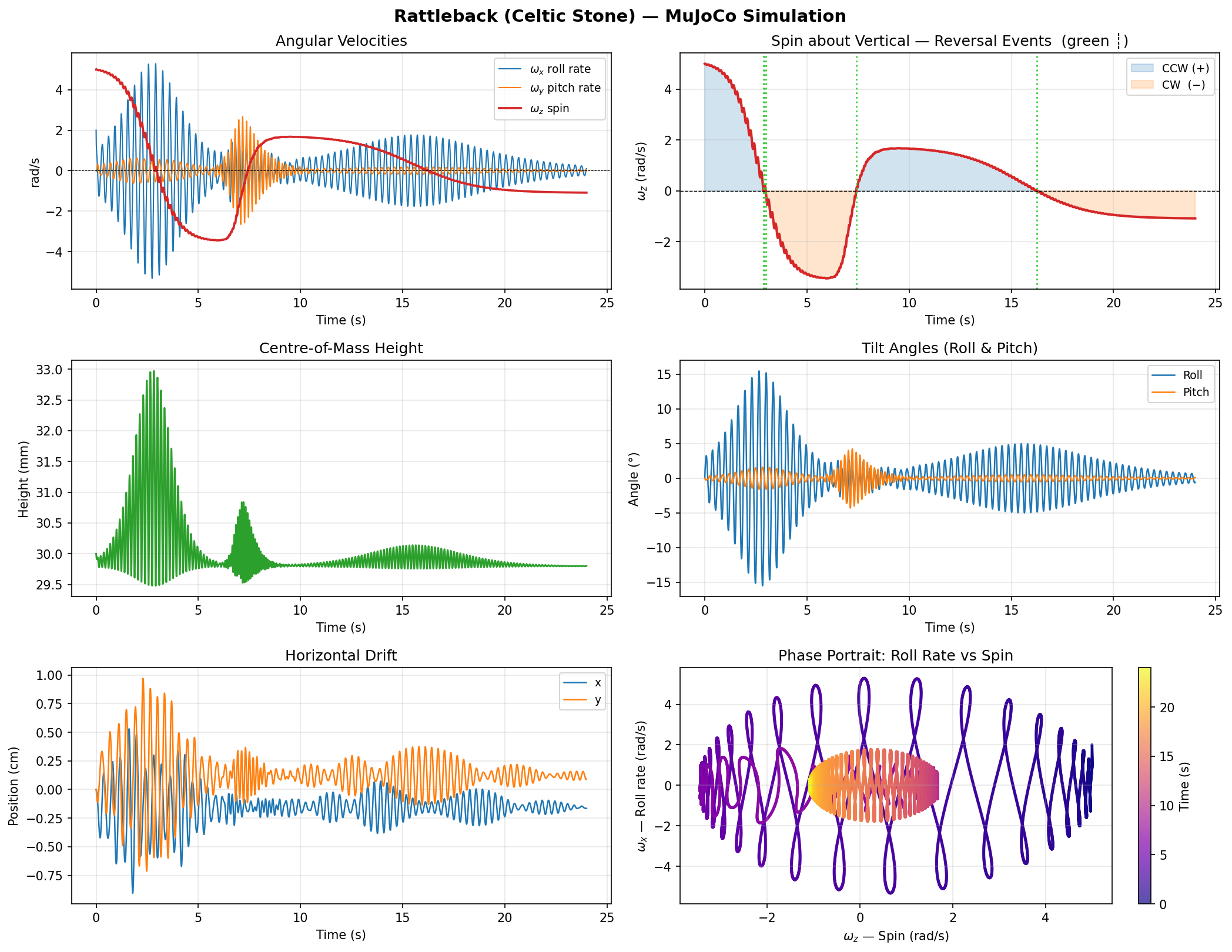
The rattleback (also called a Celtic stone or celt) spontaneously reverses its spin direction when placed on a flat surface and given an initial spin in the wrong direction — without any apparent external cause.
Physics
The reversal is driven by a gyroscopic coupling between the spin mode and the rocking (pitch/roll) modes, created when the body’s principal inertia axes are tilted relative to its geometric axes.
Geometry
The simulated body is a solid ellipsoid with semi-axes:
- $a = 0.12$ m (long axis)
- $b = 0.06$ m (wide axis)
- $c = 0.03$ m (vertical axis)
The body origin is placed at $z = c$ so the stone rests tangent to the ground plane at $t = 0$.
Inertia
Diagonal principal moments for a uniform solid ellipsoid of mass $m = 0.5$ kg:
\[I_x = \frac{m(b^2+c^2)}{5} = 4.50 \times 10^{-4}~\text{kg·m}^2\] \[I_y = \frac{m(a^2+c^2)}{5} = 1.53 \times 10^{-3}~\text{kg·m}^2\] \[I_z = \frac{m(a^2+b^2)}{5} = 1.80 \times 10^{-3}~\text{kg·m}^2\]Asymmetry
The inertia principal frame is rotated $\alpha = 20°$ about body $z$ relative to the geometric axes, introducing an off-diagonal body-frame coupling:
\[I_{xy} = \frac{I_y - I_x}{2}\sin(2\alpha) \approx 3.47 \times 10^{-4}~\text{kg·m}^2\]This $I_{xy}$ term causes a spin about $z$ to generate a gyroscopic torque in the $x$–$y$ plane, which excites rocking. The rocking in turn torques the spin toward zero and then past it — reversing the direction.
MJCF Model
The inertia tilt is set in rattleback.xml with a single attribute:
<inertial pos="0 0 0" mass="0.5"
          diaginertia="4.5e-4 1.53e-3 1.8e-3"
          euler="0 0 20"/>
euler="0 0 20" rotates the principal-axes frame 20° about $z$ relative to
the body frame, creating the $I_{xy}$ coupling without altering the ellipsoid
shape. The axis cylinders attached to the body (red = $x$, green = $y$,
blue = $z$) visualize the geometric frame rotating with the stone.
Initial Conditions
A pure vertical spin ($\omega_z \ne 0$, all other rates zero) is an exact equilibrium: the $I_{xy}$ coupling drives spin into roll/pitch only when angular momentum already has a transverse component.
A perfectly upright initial state would spin indefinitely without reversal.
The small seed roll rate $\omega_x = 2\ \text{rad/s}$ (SEED_ROCK in the script) plays the role of the inevitable imperfection when placing a real stone on a surface, allowing the gyroscopic instability to grow.
Running the Simulation
cd rattleback
python rattleback_sim.py
Outputs written to the same directory:
| File | Contents |
|---|---|
rattleback_sim.mp4 |
Rendered 3-D video (1280 × 720, 60 fps) |
rattleback_states.png |
Six-panel state plots |
See Setup & Installation for environment and dependency instructions.
Live Simulation
Downloading MuJoCo WASM (~10 MB)…